
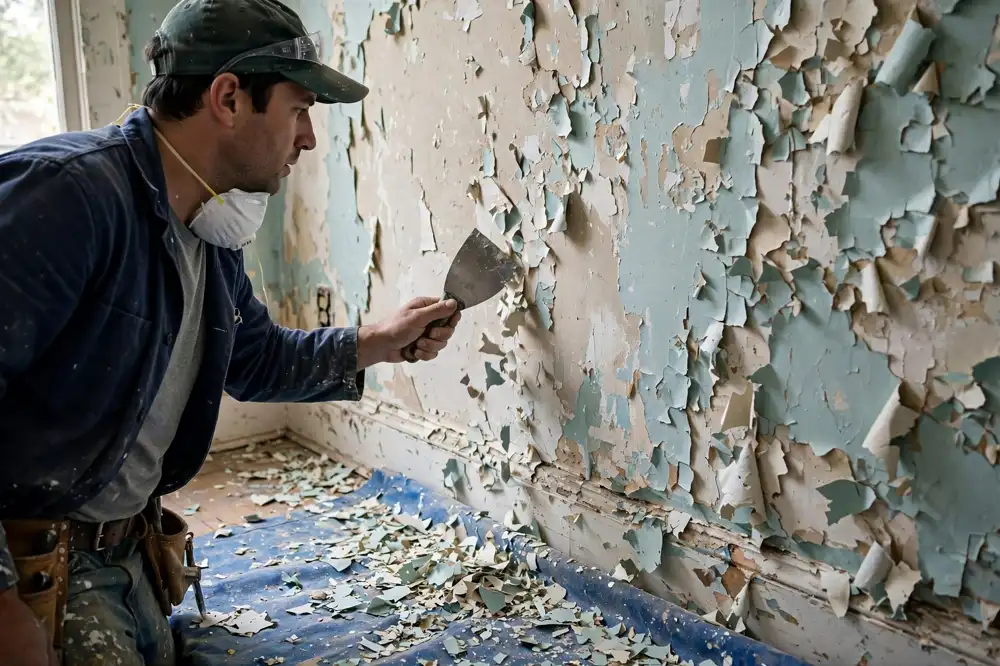
Every wall has a limit. Coat after coat, year after year, paint builds into a thick skin — and underneath, life has been happening: a little damp from the bathroom wall, hairline cracks moving with the building, an old layer of cheap paint that never really bonded. Then one summer the surface starts to let go: a bubble by the skirting, a flake on the balcony wall, a patch that peels like sunburn. The temptation is to paint over it and buy another year. Sometimes that works. Often, it buys a few months — and makes the eventual job bigger. Here is how to tell the difference.
Signs the Old Paint Has to Come Off
- Peeling and flaking in more than one spot — the bond between layers has failed, and new paint bonds to the failing layer, not the wall
- Bubbling after every repaint — moisture or a weak layer underneath keeps pushing the surface off
- A soft, thick, uneven build-up — you can feel the layers; edges and corners have gone rounded and lumpy
- Paint coming away in sheets when tape or a scraper touches it — what is underneath is no longer holding anything
- Old oil or enamel paint that modern paints will not grip without removing or properly sealing
If the problem is one small patch from a known, fixed leak, local repair is fine. If you are nodding at two or three signs on the list, removal is the honest job.
What Paint Removal Actually Involves
It is methodical, dusty work — anyone who promises it clean is not being straight with you. The room is emptied or sheeted properly, floors protected, and the old paint comes off section by section: scraping and sanding for most interior walls, with care taken not to tear up the plaster beneath. Wood and metal — doors, cabinets, grills — are worked back toward a clean base where possible. The debris is bagged and cleared as the work goes, not left in a pile for you.
The Part Nobody Sees in the Brochure: What Is Underneath
Stripping a wall is also an inspection. This is usually when the real story appears — the damp patch that was painted over twice, the crack that was filled with the wrong material, filler from a decade ago crumbling out. None of it is a disaster; all of it is easier to fix now, on a bare wall, than under three fresh coats. After removal, the surface is repaired honestly, primed so the new paint has something sound to hold, and only then painted.
Why the Repaint Lasts Longer Afterwards
New paint lasts as long as whatever it is stuck to. On a stripped, repaired, primed surface, that is the wall itself — and a finish measured in many years. On a failing old skin, the new paint is only as strong as the weakest layer under it, which is why “we repainted last year and it is already peeling” is the most common sentence we hear on these jobs.
Dubai-Specific Notes
In older Deira and Karama buildings, walls may carry decades of layers, including old oil-based paints — allow time for proper removal rather than a rushed cover-up. In coastal areas, salt in the air works on exterior paint from both sides; if the outside is flaking, check the wall for damp before repainting, not after. And if your building requires a work NOC, arrange it before the noisy, dusty days, not during.
Not sure whether your walls need removal or just repainting? Send close-up photos of the peeling or bubbling areas to BAKTH Technical Service on WhatsApp — 056 360 4092. We will tell you honestly which job your wall needs, and confirm the exact price before any work starts.
If your walls need the job itself, our Paint Removal in Dubai page explains what the service includes and how to get your exact price.